
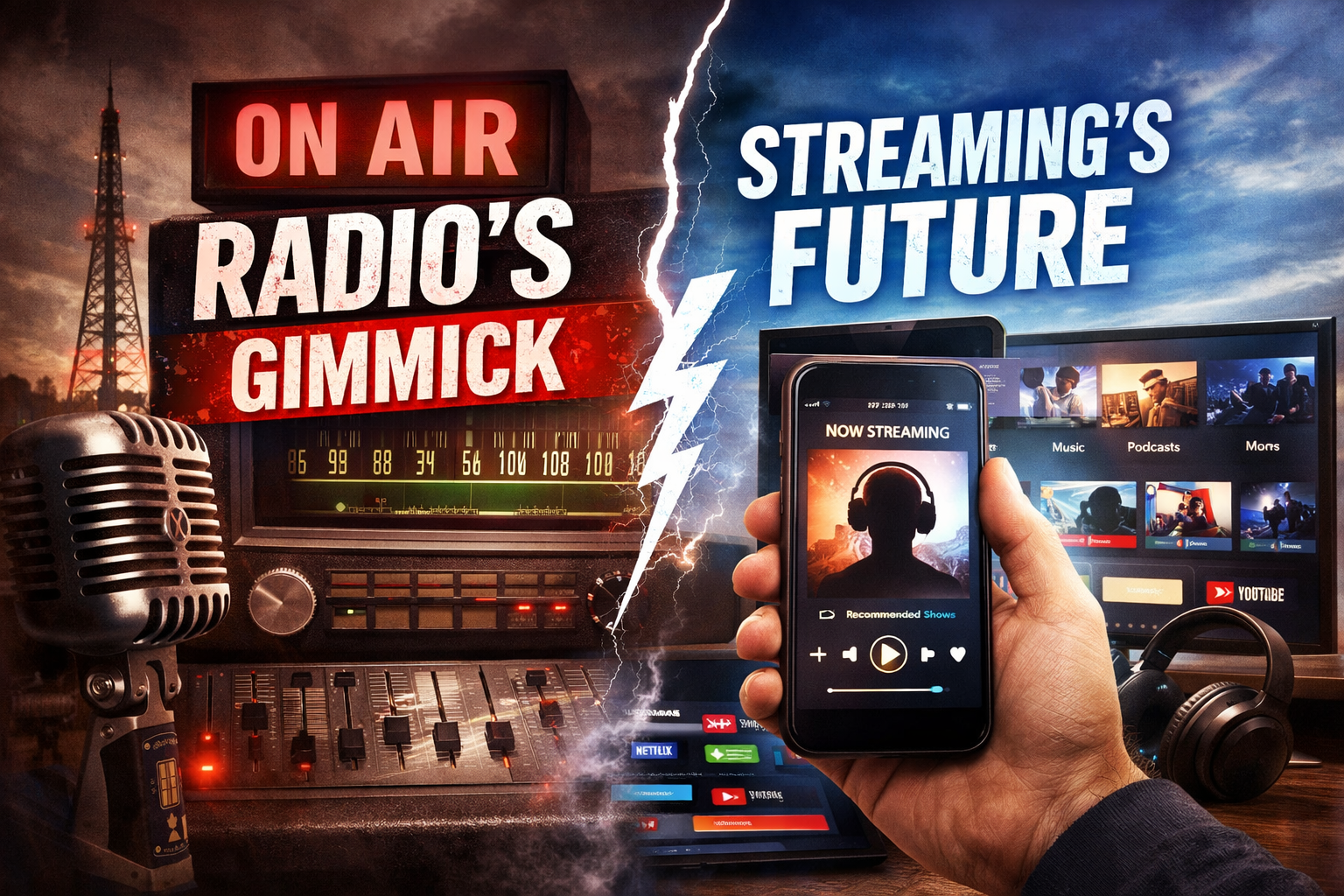
Radio people love to say, “Stream us online.” That line sits in every promo. It sits on every website. It sits in every sales deck.
Then the industry turns around and treats streaming like a side project.
On February 5, 2026, SummitMedia engineering VP Jeff McGinley said streaming is “almost on the same level” as keeping transmitters on the air. He tied it directly to sales packaging and metadata accuracy.
That is honest. It is also a warning.
“Almost” is what you say when the old system still gets priority.
Television did not survive the last decade by treating streaming as “almost.” It survived by treating streaming as the main road.
NAB sees the numbers. Radio leadership still dodges the conclusion.
NAB has argued that broadcast TV held 19.1 percent of total viewing time in August 2025, and streaming held 46.4 percent. NAB cited Nielsen data in an ownership filing story.
So yes, they see the shift. They can describe it with precision.
But the public posture stays stuck in protection mode. The loudest fights still focus on rules, caps, and keeping the legacy engine alive.
That might win a regulatory battle. It does not win the next decade.
Here is the hard part. If streaming is treated as a defensive add-on, radio becomes a utility, not a habit.
Big radio groups talk digital. They still center broadcast.
Look at iHeartMedia’s own reporting. In Q3 2025, iHeart said Digital Audio Group revenue was $341.691 million, up 13.5 percent year over year.
Digital is not a rounding error. It is a growth engine.
So why does broadcast still run the plan?
Radio groups keep acting like streaming is a mirror of the FM signal. Same programming clock. Same stopset logic. Same “good enough” sound assumptions. Same weak product thinking.
Streaming is not a mirror. Streaming is the product.
Here is the question radio avoids.
Is your station a frequency, or is your station a service?
It is a service. It always was. The frequency just used to be the delivery method.
That answer changes everything.
When leaders treat streaming as a gimmick, they tell listeners this: “We built this for the past, not for you.”
SummitMedia’s interview shows the gap between tech choices and business choices.
McGinley described a company-wide change at the start of 2024. SummitMedia moved stations to Telos Forza processing with Z/IPStream, then sent streams to RCS Revma.
That is real work. It is modern engineering.
He also highlighted level matching issues tied to inserted stream ads, plus the sales lift from synchronized text and image ad tools.
That is the tell. The “why” keeps coming back to packaging and insertion.
That is not evil. It is incomplete.
Streaming wins when it treats the listener as the customer, not the ad unit.
What television did that radio still refuses to do
Television stopped acting like streaming was a repackaged channel feed. They built around how people watch.
Radio still thinks in hours and breaks. Streaming thinks in sessions and choice.
Television invested in user experience, content discovery, and on-demand libraries. Radio still treats apps like a logo holder and a play button.
Television built habits that survive outside the home. Radio still bets on commutes and car presets.
You can keep a transmitter on and still lose the culture.
The “gimmick” tells show up in the day-to-day details
Start with sound. Engineers still hear “it’s just a stream” far too often. McGinley called out the exact mindset, the idea that laptop speakers make quality irrelevant.
That mindset is dated. People listen on earbuds, smart speakers, car systems, and Bluetooth setups.
Then there is data. Metadata accuracy should be table stakes, not a special project. McGinley described constant attention to “correct metadata.”
If your stream cannot reliably show song and artist info, you are not competing. You are coasting.
Then there is latency. Radio treats stream delay as an annoyance. Sports proves it is a product flaw. McGinley said live sports is the main place people notice the delay.
That is correct, and it is still a warning. Streams need product owners, not excuses.
Pros and cons of the “broadcast-first” mindset
Pros. Broadcast-first keeps legacy revenue stable. It protects current workflows. It reduces short-term risk.
Cons. Broadcast-first traps innovation behind old rules. It keeps streaming in a support role. It builds a weaker habit with younger listeners. It turns radio into background noise that other apps can replace.
That second list is the future invoice.
What I want NAB and major groups to say out loud
Say this, clearly, in public.
Streaming is not “online access” to radio. Streaming is where radio competes for attention.
Then fund it like it matters.
Put the best programming minds on the stream product, not only the FM clock. Build streaming-only features that listeners can feel. Fix ad load logic so it respects session listening. Make the app experience fast and stable. Treat metadata, artwork, and reliability as core engineering.
Stop calling streaming “part of the package.” That language makes it sound like a novelty.
Close
Radio can still win. Audio is not dead. Radio is not dead.
But the industry leadership has to stop acting like streaming is a gimmick that supports the “real” product.
Streaming is the product. Broadcast is one delivery method.
Television learned that lesson in public. Radio keeps learning it in private.
That has to end.
Jason Davenport is a seasoned media professional with over two decades of experience in the fields of broadcasting, audio/video production, and media consulting. Based in Montgomery, Alabama, Jason is the owner of Deep South Media, where he specializes in providing innovative solutions for clients, including podcasting, blogging, web design, and social media management.