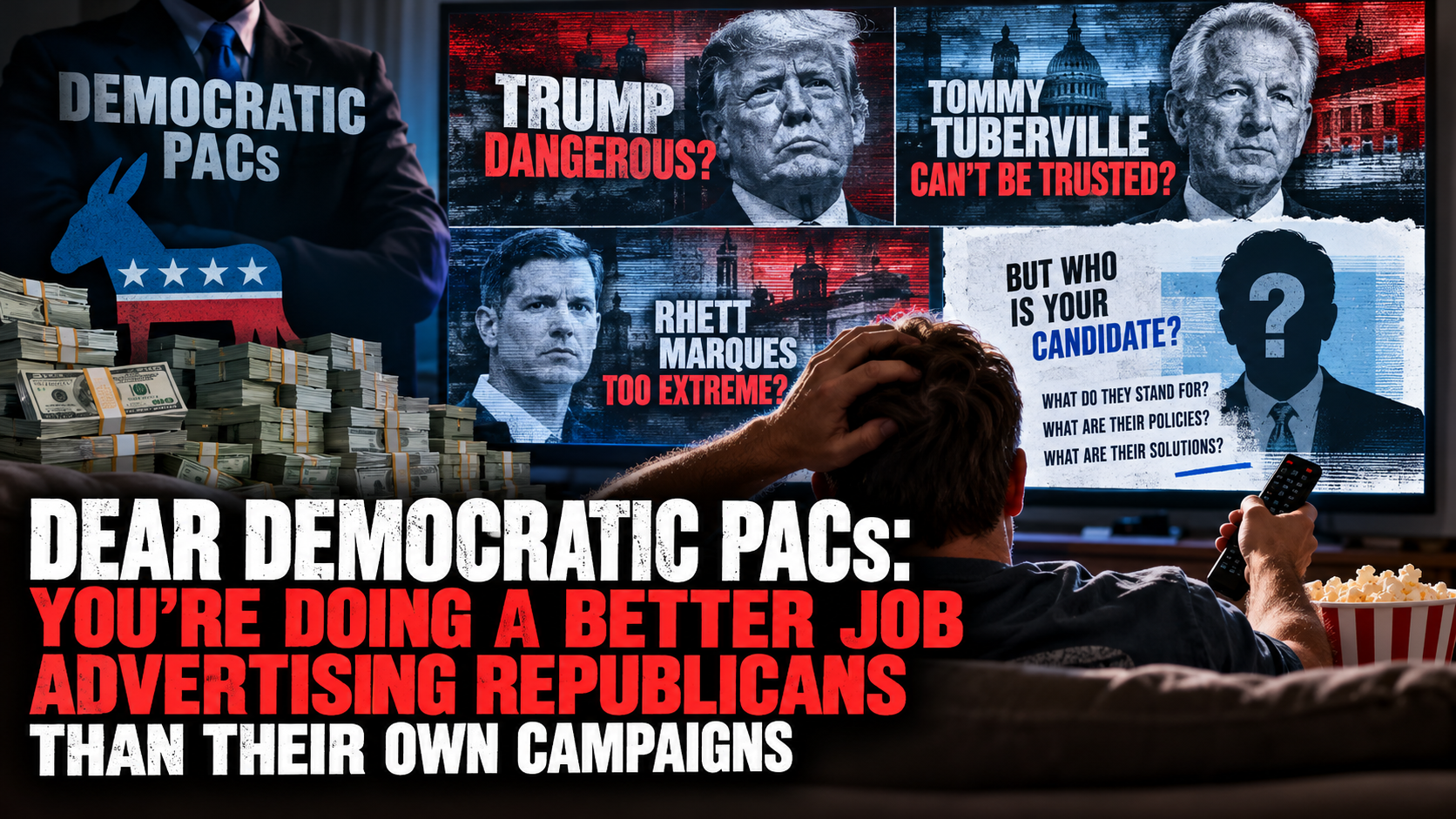
After months of political attack ads targeting Donald Trump, Tommy Tuberville, and other Republicans, I’ve developed a serious case of election commercial fatigue. And the message I’m taking away probably isn’t the one these groups intended.
By Jason Davenport | Southern Signal
I have a message for the Democratic political action committees flooding television screens, social media feeds, and streaming platforms with political advertisements.
Congratulations.
You’ve spent much of this election cycle giving me reasons to take another look at the very Republicans you’re trying to defeat.
Donald Trump. Tommy Tuberville. Rhett Marques. And countless other Republican candidates across Alabama and the rest of the country.
Their names are practically unavoidable.
And the irony is that some of their most persistent advertising seems to be coming from organizations that desperately want voters to reject them.
I don’t know how much money these groups have spent trying to influence my political opinions personally, but I can tell you what the results have been.
I’ve developed a significant case of election commercial fatigue.
And instead of making me more interested in the Democratic candidates these organizations presumably want elected, their advertisements have left me asking a question that apparently never occurred to the people producing them.
Who the hell are your candidates, and what exactly are they running on?
Millions of Dollars to Remind Me Republicans Exist
Political advertising has always involved attacking the opposition. That’s nothing new.
But this election cycle seems to have taken the strategy to an entirely different level.
According to reporting from the Associated Press, Democrats and allied organizations spent more than $163 million on advertisements mentioning President Donald Trump between September 1 and late October.
Think about that.
Millions upon millions of dollars spent keeping the name Donald Trump in front of American voters.
And this is a midterm election. Trump isn’t even on the ballot.
Yet judging by the advertisements, you’d think every race for Congress, governor, or some other public office was nothing more than another referendum on the president.
Here in Alabama, the pattern is familiar.
Political advertisements target Tommy Tuberville or Rhett Marques, telling audiences what they’re supposedly doing wrong, what positions they allegedly hold, and why voters should be concerned about them.
But here’s where the strategy loses me.
After hearing all the reasons I’m supposed to dislike a Republican candidate, I’m still left wondering why I should support the Democrat.
What is that candidate proposing?
What’s their record?
What policies are they advancing?
What makes them a better alternative?
Apparently, those details aren’t always important enough to fit into a 30-second commercial.
But there’s plenty of room for another attack.
You’re Selling Me Opposition, Not an Alternative
I understand political advertising.
I’ve spent years in broadcasting. I understand branding, marketing, repetition, and the importance of putting a message in front of an audience.
But one of the fundamental principles of advertising is that you need to give people a reason to consider what you’re offering.
Imagine a business spending millions of dollars running commercials criticizing its biggest competitor.
The competitor is too expensive. Its customer service is terrible. Its products are unreliable.
Thirty seconds later, the commercial ends.
You still don’t know what the advertised business sells, what makes its products better, or why you should spend your money there.
You just know the competitor’s name.
Over and over and over again.
At some point, the advertiser has to wonder whether it’s promoting its own business or providing free brand recognition to the competition.
That’s exactly how these political advertisements are beginning to feel to me.
Democratic-aligned PACs seem determined to make Donald Trump the center of nearly every political conversation.
They want me thinking about Tommy Tuberville.
They want me thinking about Rhett Marques.
They want me thinking about Republicans.
Mission accomplished.
But they’ve done remarkably little, at least through the advertisements I’ve encountered, to make me equally interested in the people running against them.
You cannot expect voters to develop confidence in your candidate when your advertising spends most of its time talking about somebody else.
Here’s the Part You Probably Won’t Like
The more I’m told that I should dislike a particular politician, the more inclined I become to examine that politician’s actual positions for myself.
That doesn’t mean an attack advertisement automatically makes its target right.
It doesn’t mean Trump, Tuberville, Marques, or any other Republican deserves unquestioning support.
And it certainly doesn’t mean allegations should be dismissed simply because they appear in political advertising.
But constant negativity isn’t a substitute for persuasion.
If an organization wants me to reconsider my opinion of Donald Trump, present verifiable facts and explain their significance.
If it wants me to question Tommy Tuberville, address his record and explain how another candidate would govern differently.
If it wants me to oppose Rhett Marques, make a substantive case for the alternative.
What doesn’t work for me is the assumption that repeating a politician’s name alongside ominous music and carefully edited sound bites will somehow settle the argument.
In fact, it’s increasingly having the opposite effect.
I’m becoming more skeptical of the advertisements themselves.
And if your entire pitch is that a Republican candidate is terrible, without giving me anything meaningful about the Democrat, you’ve accomplished very little beyond reminding me that the Republican exists.
That’s an expensive way to lose my attention.
“No Kings!” But Don’t Question the Party
There’s another layer of irony in all this.
For months, the political conversation has been saturated with rhetoric about authoritarianism, democracy, and the “No Kings” movement.
We’re told that Americans must challenge those in power, question authority, and hold elected officials accountable.
I agree with that principle.
But shouldn’t it apply to everyone?
Shouldn’t Democratic candidates be subjected to the same scrutiny as Republicans?
Shouldn’t voters demand answers from both sides about spending, taxes, healthcare, education, immigration, and government accountability?
Or are we supposed to accept the idea that identifying the correct political villain is all the information necessary to cast a ballot?
Opposing Donald Trump isn’t a comprehensive policy platform.
Disliking Tommy Tuberville isn’t an economic development plan.
Attacking Rhett Marques isn’t a proposal to improve public education or healthcare.
Those may be political positions, but they aren’t substitutes for governing.
And no amount of chanting about democracy changes that.
Alabama Has Real Problems. Let’s Hear Real Proposals.
Alabama isn’t suffering from a shortage of political arguments.
We have plenty of those.
What we need are serious conversations about the issues affecting the people who live here.
How do we address the financial pressures facing rural hospitals?
What should be done about the rising cost of living?
How do we improve public education while remaining accountable to taxpayers?
What policies would encourage investment and create better-paying jobs?
How do we maintain infrastructure without continually placing additional financial burdens on working families?
And when candidates promise new programs or expanded government services, where is the money coming from?
These aren’t trick questions.
They’re basic questions about governing.
Yet I can watch several political advertisements in a row and come away knowing far more about what one political organization dislikes than what its preferred candidate intends to accomplish.
That isn’t helping me evaluate the choices on the ballot.
It’s just adding to the noise.
Republicans Aren’t Innocent, Either
Before the inevitable accusations start, yes, Republicans run negative political advertisements.
Some of those advertisements are every bit as repetitive, inflammatory, and short on substance.
I have no intention of defending that approach simply because the advertiser has an R next to its name.
My criticism is directed toward the Democratic-aligned advertising that has dominated my own viewing experience and the strategy behind it.
Republican PACs should face the same questions.
But I’m also not going to pretend my personal experience has been evenly divided between the parties just to make this column sound politically balanced.
I’m writing about the advertisements I’ve encountered and how they’ve influenced my perception of the campaign.
And from where I’m sitting, a substantial portion of the Democratic-aligned messaging has done a better job of keeping Republican names in circulation than introducing me to compelling Democratic alternatives.
That may not be the message the PACs intended to deliver.
But it’s the one I’m receiving.
My Remote Control Has Reached Its Breaking Point
Perhaps the most frustrating part of this entire election cycle is the assumption that voters need to be constantly reminded whom they should fear, dislike, or distrust.
It’s exhausting.
After enough negative advertisements, the voices become interchangeable. The ominous soundtracks sound identical. Every candidate is supposedly dangerous. Every election is supposedly the most consequential in American history.
Eventually, the message stops being persuasive.
It becomes background noise.
And when that happens, people tune out.
As someone who has spent much of his professional life in broadcasting, I can tell you that losing an audience’s attention is rarely a successful advertising strategy.
Yet political organizations continue pouring money into commercials that apparently assume the public has an unlimited appetite for outrage.
I don’t.
And I doubt I’m alone in that sentiment.
A Final Word to the Democratic PACs
If your goal is to convince me that Donald Trump, Tommy Tuberville, Rhett Marques, or another Republican candidate is unworthy of support, you’re going to need more than another recycled attack commercial.
Give me the facts.
Show me the record.
Explain the consequences of the policies you’re criticizing.
But more importantly, tell me about the candidate you actually want elected.
Tell me what that person intends to accomplish.
Tell me how their proposals would work.
Tell me what those proposals would cost.
And tell me why the alternative deserves consideration on its own merits.
Because I don’t choose political candidates simply based on whom someone else tells me to hate.
And I refuse to pretend that relentless negativity constitutes a meaningful political platform.
For all the money Democratic-aligned PACs have spent trying to convince audiences to reject Republicans, their advertising has left me spending more time hearing Republican names than learning about Democratic candidates.
If your objective is to persuade people like me, that’s a problem worth examining.
So here’s some unsolicited advice for the political advertising industry.
Stop assuming voters only need a villain.
Start giving them something substantive to evaluate.
And for the love of broadcasting, give the ominous music and endless attack commercials a rest.
Because right now, the only thing I’m completely convinced of is that I’ve had enough.

Jason Davenport is a seasoned media professional with over two decades of experience in the fields of broadcasting, audio/video production, and media consulting. Based in Montgomery, Alabama, Jason is the owner of Deep South Media, where he specializes in providing innovative solutions for clients, including podcasting, blogging, web design, and social media management.