
By Jason Davenport | Opinion
When military bravado replaces common sense, even a decorated veteran can mistake stubbornness for leadership.
There’s something remarkable about watching a man diagnose America’s political failures while refusing to recognize the contradictions in his own argument.
Enter Troy Carico.
In his latest 1819 News column, A Funeral with Confetti, Carico mourns Republican losses in the midterms while celebrating Tommy Tuberville’s victory in Alabama.
But beneath the political theatrics lies something considerably more troubling: a man so committed to his war-first philosophy that he seems incapable of recognizing its consequences.
Carico believes President Trump failed because he negotiated rather than delivering the overwhelming military conclusion Carico wanted.
Apparently, the problem wasn’t the war.
It was that America didn’t wage enough of it.
And that, ladies and gentlemen, is where his argument collapses under its own weight.
The Man Who Wants to Have It Both Ways
Just days before the election, Carico warned that soaring fuel prices and economic uncertainty were crushing American families.
Farmers. Truckers. Small businesses. Working-class Americans.
He correctly recognized their financial suffering.
Then came his solution.
More military force.
Not a clearly defined diplomatic settlement. Not an examination of whether continued escalation served American interests. Just the familiar rhetoric of crushing the enemy until there’s nothing left to negotiate.
Here’s the problem, Troy.
You cannot condemn the economic consequences of war while casually advocating its escalation without explaining how your strategy avoids making those consequences worse.
Military escalation carries costs, risks, and unpredictable consequences.
Additional strikes don’t guarantee cheaper gasoline. More bombs don’t guarantee reopened shipping lanes. And destroying military infrastructure doesn’t necessarily produce political surrender.
Yet Carico treats these inconvenient realities as though acknowledging them constitutes weakness.
That’s not strategy.
That’s an argument built on wishful thinking and wrapped in military credentials.
An Election Isn’t a Blank Check for Your Opinions
Carico now points to Republican losses as vindication of his warnings.
But predicting political disaster doesn’t automatically validate your preferred solution.
Americans frustrated by war and economic hardship aren’t necessarily demanding a larger war.
That’s a distinction Carico conveniently overlooks.
He takes a complicated national election, reduces it to his preferred foreign policy grievance, and declares himself correct.
No serious examination of whether further escalation might have deepened voter dissatisfaction.
No convincing explanation of how his approach would have lowered costs.
Just another lecture about strength, resolve, and the supposed cowardice of negotiation.
Troy, repeating your opinion after an election doesn’t magically transform it into evidence.
It merely makes the repetition louder.
Military Experience Isn’t Political Infallibility
Let me make something perfectly clear.
Carico’s military service deserves respect.
But serving one’s country doesn’t grant permanent immunity from having one’s political judgment questioned.
Nor does it mean every disagreement over military strategy should become a referendum on someone’s courage.
Carico invokes Machiavelli, battlefield doctrine, and the necessity of crushing adversaries.
Impressive language.
But military vocabulary isn’t a substitute for a coherent national strategy.
Wars aren’t won simply because somebody delivers the most aggressive speech.
And foreign policy isn’t a contest to determine who can sound toughest while other Americans shoulder the consequences.
Sometimes strength requires military action.
Sometimes it requires knowing when military action has accomplished everything reasonably achievable.
And sometimes it requires negotiating with people we despise.
That’s diplomacy, Troy.
Not surrender.
A statesman understands the difference. A political commentator should at least be willing to acknowledge it.
Fortress Alabama and the Hypocrisy of America First
Carico enthusiastically celebrates Tuberville’s vision of a Fortress Alabama.
Lower taxes. Conservative governance. Economic security. Putting Alabama families first.
Fine principles.
But apparently those principles become negotiable when Carico’s preferred foreign conflict enters the conversation.
He demands fiscal responsibility at home while offering little accounting of what further military escalation might cost abroad.
He worries about Americans struggling financially, then advocates policies that could deepen their hardship.
And somehow we’re supposed to accept this as principled conservatism?
No.
It’s selective conservatism.
You don’t get to preach America First while treating American economic consequences as an afterthought.
If your foreign policy demands additional sacrifice from working Americans, you owe them more than battlefield slogans.
You owe them an achievable objective, a credible exit strategy, and an honest accounting of the costs.
Carico offers plenty of certainty.
Convincing answers are considerably harder to find.
The Funeral Carico Didn’t Recognize
The central problem with Troy Carico’s argument isn’t his patriotism.
It’s his apparent inability to distinguish military aggression from effective leadership.
He assumes the hardest punch necessarily produces the best outcome.
History offers ample reasons to question that assumption.
President Trump deserves scrutiny for his decisions. So does every politician who supported the conflict.
But questioning military escalation isn’t weakness.
Demanding an actual endgame isn’t cowardice.
And recognizing that negotiation can advance American interests isn’t surrender.
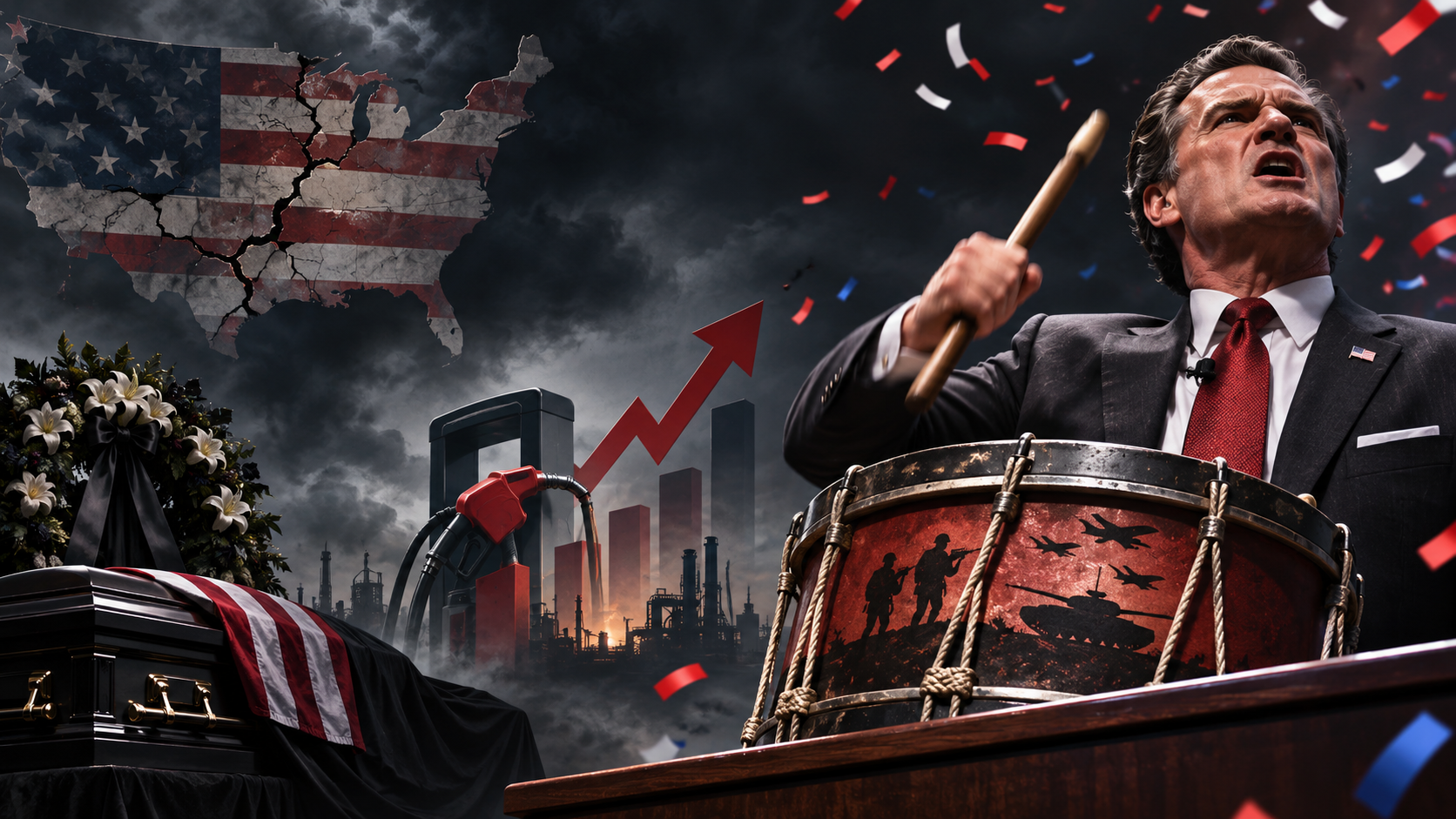
Carico titled his column A Funeral with Confetti.
Perhaps he accidentally identified something worth burying.
Not conservatism. Not patriotism. Certainly not America’s military strength.
But the intellectually bankrupt notion that the man demanding the most bombs must also possess the most wisdom.
Troy Carico can keep beating the war drums.
The rest of us are entitled to ask whether he has a plan beyond making them louder.
Jason Davenport is a seasoned media professional with over two decades of experience in the fields of broadcasting, audio/video production, and media consulting. Based in Montgomery, Alabama, Jason is the owner of Deep South Media, where he specializes in providing innovative solutions for clients, including podcasting, blogging, web design, and social media management.