
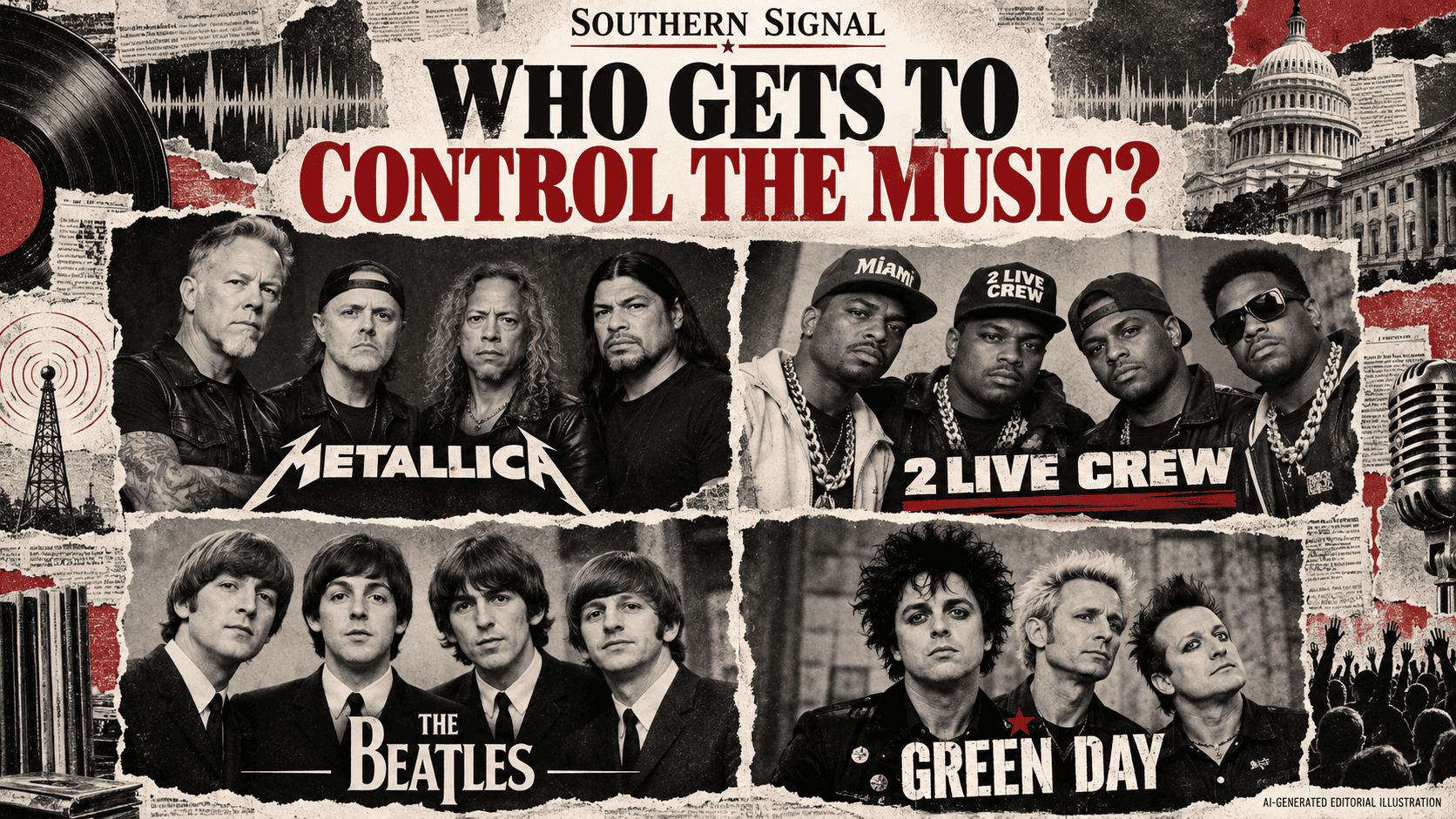
From segregationist attacks on rock and roll to Tipper Gore’s warning-label campaign, the fight over music has always reached beyond the record store.
James Hetfield thanked a Las Vegas crowd for coming to hear Metallica and offered something increasingly welcome: a night away from everybody else’s political instructions.
At Sphere on October 10, Hetfield criticized entertainers who try to influence their audiences and described Metallica’s agenda as “love, energy and heavy music, baby!” He did not name a party, candidate, Green Day or Rage Against the Machine in the reported remarks.
I welcome that approach. Buying a concert ticket should not require surrendering your independent judgment at the door.
The argument over music and politics, however, has a history that complicates the Democratic Party’s association with cultural freedom.
Democratic figures have participated in efforts to manage music’s influence, from the segregationist political world of the South to the Washington campaign for explicit-content warnings. These were different movements with different objectives. Both deserve scrutiny.
Restricting what people hear can also narrow their opportunities to question what they have been taught. Music’s ability to open those questions is part of how it helped shape this country.
When the music challenged segregation
In the 1950s, rock and roll carried Black musical traditions into an expanding mainstream. Elvis Presley drew from blues, gospel, country and other influences. Chuck Berry, Little Richard and Fats Domino helped create the music that was changing American life.
The objection from segregationists went deeper than suggestive dancing. Their social order depended on keeping Black and white Americans apart, including in their imaginations.
Historian Michael T. Bertrand describes a 1956 gathering led by Asa Carter in north Alabama. Carter’s White Citizens’ Council faction worried that Black radio and rock and roll were changing white teenagers’ racial attitudes. The group organized an effort to persuade businesses to remove the music from jukeboxes, with Elvis among its targets.
The concern was explicit: listeners were beginning to think differently, and the people defending segregation wanted to stop it.
Carter later became a speechwriter for Democratic Governor George Wallace. His earlier campaign against rock was a local segregationist effort, not a national Democratic Party program, but its leader went on to help give Alabama’s segregationist governor his voice.
Many of the Southern politicians defending segregation were Democrats. Their power rested in a society organized around racial hierarchy, and the music was helping young people form attachments that crossed it.
You cannot insist that people remain strangers to one another while their voices fill the same bedrooms, diners and car radios. Familiarity can make inherited prejudice harder to defend. A teenager who admires a Black musician has encountered something the segregationist’s lecture cannot easily explain away.
That does not mean every rock fan became a civil rights advocate. Music is capable of opening a question without determining the answer. That possibility was part of its power.
The Democratic history also includes Lyndon Johnson signing the Civil Rights Act of 1964 and Democrats working with Republicans to overcome the Southern obstruction. Those facts belong beside the party’s segregationist record. The coalition changed, and its members fought one another.
The party’s reformers deserve credit. Its defenders of segregation remain responsible for their own record.
How music helped change the country
Music’s influence extended beyond challenging racial boundaries. It gave people a way to carry ideas into daily life, remember them and share them with others.
“We Shall Overcome” developed through religious and labor traditions before becoming an anthem of the civil rights movement. Organizers and singers carried it between communities, connecting struggles that might otherwise have remained separate.
A song could hold a group together when a speech had ended. It could give frightened people something they could do together. That helped turn private convictions into public resolve.
During the Vietnam era, musicians including Bob Dylan and Pete Seeger helped develop the antiwar protest song. Music became a way to argue about national purpose and the human costs of war, not merely personal taste.
A record could introduce an argument about the country. The listener still had to decide whether it held up.
Popular music also made arguments about adulthood itself. Who decided what young people could hear? Who defined respectable behavior? Could an artist challenge religious authority, sexual conventions or government without being treated as a threat to society?
Those questions matter to how this country developed. America was shaped by people arguing over its promises and deciding which traditions deserved to survive. Music gave that argument an audience beyond the courthouse and the campaign rally.
That does not make every offensive song profound. Sometimes vulgarity is just vulgarity. But giving authorities the power to decide which expressions are worth hearing creates a much larger problem than a bad record.
Tipper Gore and the Washington warning labels
By the 1980s, a prominent Democratic political household was again involved in a fight over music’s influence, this time over sexual and violent content rather than integration.
Tipper Gore, wife of Democratic Senator Al Gore, co-founded the Parents Music Resource Center. Susan Baker, wife of Republican Treasury Secretary James Baker, was another co-founder. The PMRC pressed for warning labels on explicit recordings.
Gore said the goal was to inform parents, not interfere with artistic freedom. Parents have legitimate reasons to want that information.
The question is what happens when a parent’s objection becomes a Washington campaign directed at an entire industry. Who decides what deserves a warning? How broadly will the standard reach? How much pressure can powerful political families apply while describing the outcome as voluntary?
Frank Zappa, Dee Snider and John Denver challenged the campaign at the 1985 Senate hearing. The eventual industry labeling arrangement was voluntary, not a federal ban. Their objections concerned the pressure and the potential consequences for expression.
The PMRC’s campaign was not equivalent to the segregationists’ attack on rock. Its critics nevertheless raised a lasting question: when does helping listeners make a choice become pressure on artists to limit the choices available?
Democrats were participants in that fight, not merely spectators watching Republican moralists police the culture. Republican connections and religious attacks on rock, including Jimmy Swaggart’s, make the responsibility broader. They do not make Tipper Gore disappear from the story.
An inconvenient party label is no reason to leave a name out of the history.
Green Day and Rage can speak and fans can disagree
Today’s argument often concerns what musicians expect from their audiences. During its televised New Year’s Eve performance welcoming 2024, Green Day changed an “American Idiot” lyric to target MAGA. [
Billie Joe Armstrong has every right to deliver that message. I have every right to find it tiresome. A fan can enjoy the band’s music without treating its frontman as a political adviser.
Understanding a political message does not oblige a listener to accept it. A fan can follow every word and still think the argument is wrong.
Rage Against the Machine has built political confrontation into its identity. Its activism is hardly a surprise, and its politics cannot simply be reduced to Democratic Party loyalty.
Its own history includes a 1993 Philadelphia appearance in which the members stood naked with tape over their mouths and the letters PMRC across their chests. They used their stage time to protest censorship.
You can credit that stand and still challenge their politics. Respect for artistic freedom does not require agreement with every cause an artist supports.
A microphone amplifies an opinion. It does not establish that the opinion is correct. An arena full of applause cannot settle an argument about government.
But the standard has to work both ways. If I defend Metallica’s decision to offer an escape, I cannot demand that every other band make the same choice. Artists decide what kind of show to perform. Fans decide whether it is worth their money.
The uncomfortable test is 2 Live Crew
That principle reaches beyond any party. It becomes harder to defend when the music is something you would rather not hear.
That is why 2 Live Crew belongs in this conversation. The group’s sexually explicit album As Nasty as They Wanna Be became the subject of an obscenity ruling in 1990. A federal appeals court reversed that ruling in 1992. Members also faced criminal obscenity charges over a performance and were acquitted.
You do not have to admire the material. You do not have to play it for your children. You can consider it vulgar and still oppose using government power to suppress it.
There is a considerable distance between deciding what belongs in your own home and deciding what other adults may hear.
Afroman made the authorities part of the song
Following a 2022 police raid on his Ohio home, he used footage of the search in music videos mocking the officers, including “Lemon Pound Cake.” Seven law enforcement personnel sued over his use of their images and statements about them. In March 2026, a jury ruled in his favor.
The officers alleged reputational harm and false accusations. Afroman defended his work as protected expression. The jury rejected their claims; that does not turn every lyric into a verified account of events.
Supporting law enforcement does not make officers immune from criticism or ridicule. A rapper does not forfeit his ability to criticize government because his delivery is crude.
Anyone who applauds rebellion only when it targets the other political team is defending a team, not a principle.
Let the audience keep its own mind
Criticism of Hetfield is also speech. An online argument is not an obscenity prosecution, and listeners have as much right to challenge Metallica as any other band.
What connects these episodes is the recurring urge to decide what role musicians must play. Sometimes they are ordered to clean up their lyrics. Sometimes they are expected to validate a political movement. Sometimes their audience is expected to agree or leave.
Democrats cannot claim artistic freedom as their permanent inheritance while overlooking the people in their own political history who tried to supervise it. Their opponents cannot invoke that record while demanding obedience from artists today.
Green Day can make its case. Rage Against the Machine can make theirs. Metallica can give people a night away from the argument. I can listen, disagree, change the station, or buy another ticket without asking permission from any of them.
One generation’s dangerous music becomes the next generation’s classic rock. The songs that once sent adults into a panic eventually become the soundtrack to their nostalgia.
Apparently, rebellion becomes perfectly respectable once everybody gets old enough to enjoy it.
Keep the music loud. Let the audience keep its own mind.
Sources
[1] The PRP, October 12 2026. October 10 remarks and embedded concert video.
[2] Smithsonian on Elvis; Rock Hall profiles of the Black rock and roll pioneers.
[3] Michael T. Bertrand, Study the South, May 4 2026. Carter and the campaign against rock and roll.
[4] Encyclopedia of Alabama. Asa Earl Carter and his work for George Wallace.
[5] National Archives. Civil Rights Act of 1964.
[5] US Senate. Bipartisan strategy and final passage.
[6] Library of Congress. Music in the Civil Rights Movement.
[6] Library of Congress. Tracing the Long Journey of We Shall Overcome.
[7] Library of Congress. The Music and Sounds of the Vietnam Era.
[8] American Yawp Reader. Statements from Susan Baker and Tipper Gore in 1985.
[9] First Amendment Encyclopedia. Tipper Gore and her stated purpose for labeling.
[10] UPI, September 19 1985. Zappa, Denver and Snider testimony.
[10] UPI, November 1 1985. Voluntary industry labeling agreement.
[11] Louder. Swaggart and the background to Miracle Man.
[12] Associated Press. Green Day Saviors review and New Year lyric change.
[12] Los Angeles Times, January 2 2024. Broadcast performance corroboration.
[13] Rage Against the Machine official biography. Philadelphia PMRC protest.
[14] First Amendment Encyclopedia. 2 Live Crew obscenity litigation.
[15] NPR via KPBS, March 19 2026. Afroman verdict and competing arguments.
Jason Davenport is a seasoned media professional with over two decades of experience in the fields of broadcasting, audio/video production, and media consulting. Based in Montgomery, Alabama, Jason is the owner of Deep South Media, where he specializes in providing innovative solutions for clients, including podcasting, blogging, web design, and social media management.