
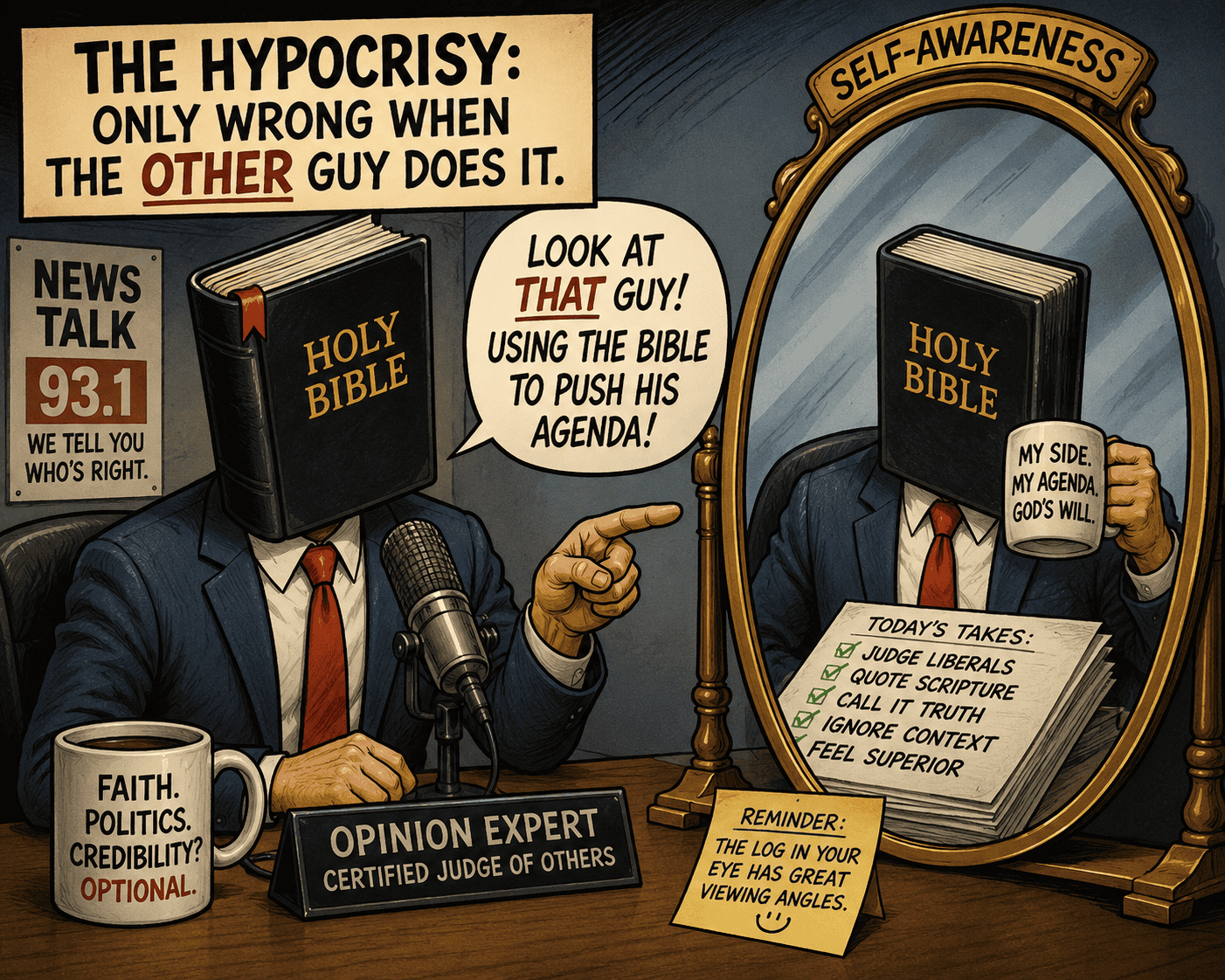
Quoting the Bible is always perilous.
Joey Clark has apparently discovered that mixing Christianity and politics can produce hypocrisy.
Welcome to the party, Joey.
In his latest 1819 News column, the WACV NewsTalk 93.1 midday host laments the criticism Tommy Tuberville receives whenever the senator posts a Bible verse on Facebook.
Some commenters mock Tuberville. Others question whether his politics reflect the Scripture he posts. Clark sees something deeper in those comments. He sees a judgmental culture eager to ridicule Christians who dare bring their faith into the public square.
There is just one problem.
Joey Clark has spent plenty of time standing in that same public square with a political flamethrower in one hand and a Bible in the other.
Now he seems surprised somebody else brought matches.
Let’s establish something first.
Tommy Tuberville has every right to post Scripture.
Every Sunday. Every morning. Every damn hour if he wants.
Christians do not surrender their faith when they enter public office, and the First Amendment certainly doesn’t require elected officials to pretend God doesn’t exist.
But publicly quoting Scripture also doesn’t grant anyone immunity from criticism.
If a politician repeatedly invokes Christianity as part of his public identity, people are allowed to ask whether his conduct matches the principles he publicly professes.
That’s not persecution.
That’s accountability.
And Clark should understand that better than most because he has repeatedly practiced his own version of it.
This is the same Joey Clark who wrote “Alabama Democrats and the tragic golden calf of race,” invoking one of the Bible’s most famous stories of idolatry to condemn the political priorities of Alabama Democrats.
Apparently questioning whether Tuberville lives according to the Scripture he posts is unfair judgment.
But comparing your political opponents to people worshipping a golden calf?
Well, apparently that’s just another day at the office.
That’s a mighty convenient theology.
Clark has even written about the danger of Christians using Scripture as a political weapon. He has acknowledged that conservatives can selectively apply biblical standards to their opponents while giving their own political tribe considerably more grace.
Again, he’s right.
The problem is Joey occasionally writes like a man who has discovered a mirror but hasn’t quite figured out which direction to point it.
His own commentary archive isn’t exactly a monastery of charitable political discourse.
This is a man who has published columns carrying titles such as “His Rotundity, Chris Christie” and “Dude looks like Alabama’s Liz Cheney.”
So spare me the funeral procession for civility because somebody called Tuberville “Florida Man” underneath a Facebook Bible verse.
Joey, you’ve been swimming in this pool.
Don’t complain because somebody splashed your side.
And that’s where Clark’s argument falls apart.
He wants us to consider whether people criticizing Tuberville are unfairly judging the senator’s Christianity.
Fine.
Let’s use the same standard everywhere.
If Tuberville’s critics should examine their motives before questioning his faith, Clark should examine his motives before wrapping political criticism in biblical language.
If liberals shouldn’t weaponize Scripture against Republicans, conservatives shouldn’t weaponize Scripture against Democrats.
If Christianity shouldn’t become another instrument of partisan warfare, that prohibition doesn’t magically expire whenever Joey Clark sits down at the keyboard.
You don’t get to hold Tuberville’s critics over the fires of biblical accountability while quietly wearing asbestos boots yourself.
Step closer, Joey.
Feel the heat.
Because Scripture doesn’t merely challenge the people leaving smart-ass comments on Tommy Tuberville’s Facebook page.
It challenges the senator posting the verse.
It challenges the Democrat mocking him.
It challenges the Republican defending him.
And it challenges the radio host writing columns about all three.
Clark actually brushes against this truth near the end of his column when he asks himself whether he quotes the Word because he wants to be esteemed, loved, honored or approved.
That’s probably the most important part of the entire piece.
So let’s add another question.
When you invoke Scripture in political commentary, are you defending Christianity?
Or are you using Christianity to defend your politics?
There is a difference.
And Christians, especially Christians with microphones, newspaper columns and political audiences, ought to care deeply about that distinction.
Because there is nothing particularly courageous about quoting Scripture when the verse conveniently reinforces what your audience already believes.
The harder test comes when Scripture points back at you.
Clark wants Americans to stop treating the Bible like another weapon in our partisan arsenal.
Good.
I agree.
Then put it down.
If we’re going to condemn people for selectively applying Christian morality to politicians they dislike, let’s condemn it consistently.
If we’re going to demand humility from people questioning Tuberville’s Christianity, let’s demand humility from commentators questioning the morality and faithfulness of their political opponents.
And if we’re going to drag hypocrisy into the sunlight, nobody gets to stand conveniently in the shade.
Not Democrats.
Not Republicans.
Not Tommy Tuberville.
And certainly not Joey Clark.
Because Clark is right about one thing.
The Word ultimately judges all of us.
Which means Joey doesn’t get to hold Tuberville’s critics’ feet to the fire without putting his own toes over the flame.
Accountability is uncomfortable that way.
Especially when the sermon starts preaching back.

Jason Davenport is a seasoned media professional with over two decades of experience in the fields of broadcasting, audio/video production, and media consulting. Based in Montgomery, Alabama, Jason is the owner of Deep South Media, where he specializes in providing innovative solutions for clients, including podcasting, blogging, web design, and social media management.