When it comes to AI, I have a love/hate relationship with its use.
When done correctly, AI can be an incredibly useful tool for broadcasters. It can help stations streamline repetitive work, develop concepts, organize information and generally make certain parts of the operation more efficient.
There are some genuinely creative uses for it.
But there is also a point where AI stops being a useful tool and starts becoming a shortcut.
Image creation is where that line becomes painfully obvious.
The content below was originally paywalled.
AI can create some impressive artwork when it’s given good direction. The technology has come a long way, and there have been some incredibly creative examples of AI-generated imagery.
But AI image generation should never replace the talents of someone who actually knows Photoshop, Illustrator or other professional image manipulation and design software.
And this is a pretty good example of why.
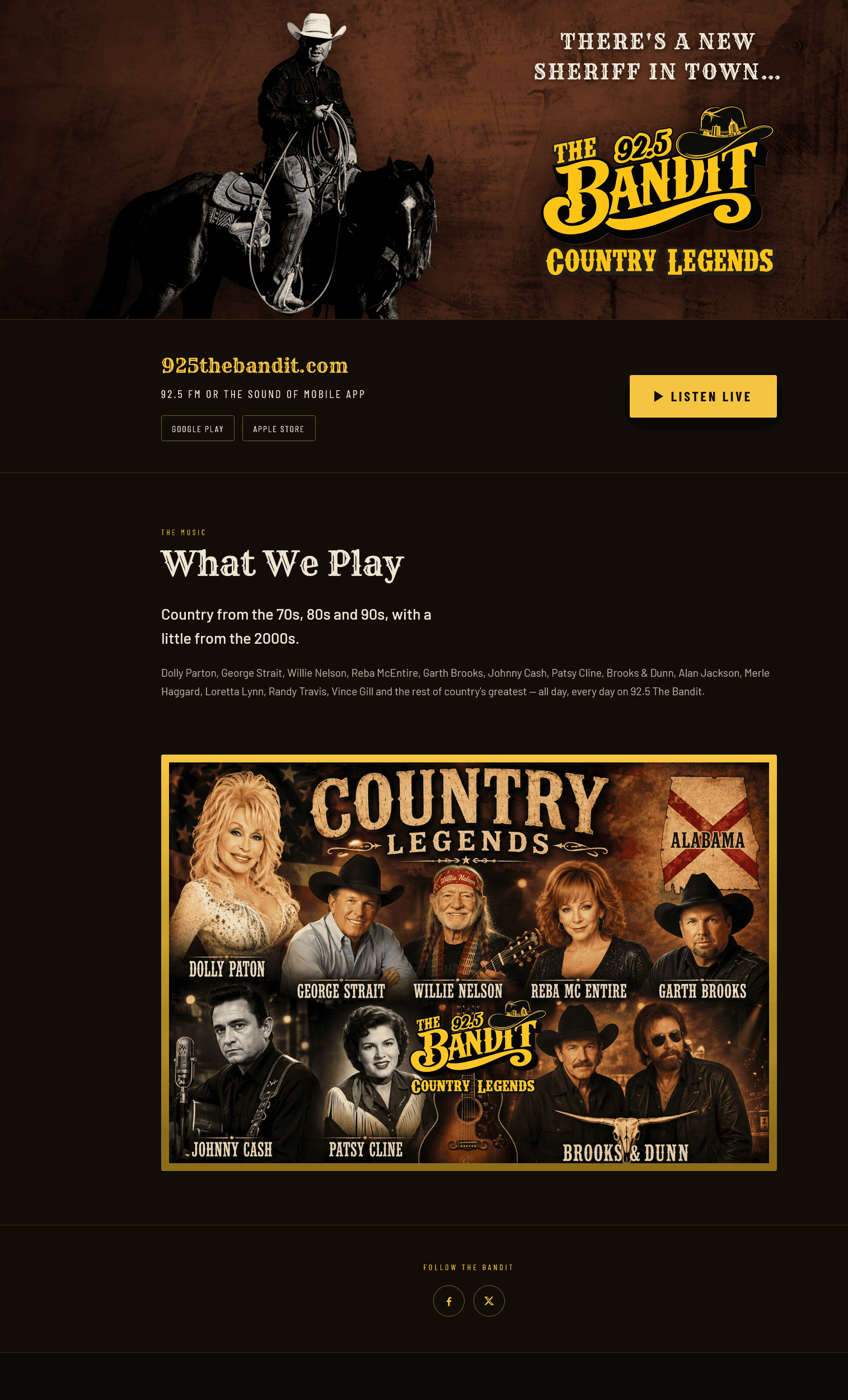
Recently, a radio station in Mobile, Alabama switched formats from Classic R&B to country as 92.5 The Bandit, Country Legends.
Looking at the station’s website, I’m going to give them the benefit of the doubt and assume it’s still a work in progress. It certainly has the appearance of a landing page that was put together quickly to get the new brand online while the rest of the website is being developed.
That’s understandable during a format change.
What isn’t understandable is the AI-generated “Country Legends” image sitting about a third of the way down the page.
At first glance, it actually looks pretty good.
You’ve got recognizable country stars, western imagery, Alabama branding and the station logo planted right in the middle. It fits the overall aesthetic they’re trying to establish.
Then you start looking closer.
And that’s when the wheels come off the wagon.
The artist names contain obvious AI-generated spelling errors and mangled lettering. You get that familiar AI version of typography where everything looks correct until you actually try to read it.
That’s the giveaway.
More importantly, that’s where somebody should have stepped in.
The problem isn’t necessarily that AI created the image. The problem is that somebody apparently treated the AI output as the finished product.
There’s a huge difference.
If you’re going to use AI to generate the foundation of an image, generate the concept. Generate the background. Generate the visual elements.
Then finish the damn thing.
Take it into Photoshop. Replace the generated lettering with real typography. Correct the artist names. Inspect the faces. Check hands, instruments, clothing, logos and all the other little details generative AI has a habit of getting wrong.
Then have another human being look at it before it goes live.
That’s basic quality control.
And we’re not talking about somebody making a funny Facebook meme for their friends.
We’re talking about a commercial radio station launching an entirely new brand in Mobile.
Your website is part of your air product now.
Your social media is part of your product.
Your streaming artwork is part of your product.
Your logo, promotional graphics and digital presence are every bit as much a representation of the station as the imaging coming out of the speakers.
That becomes even more important during a format launch.
You’re introducing yourself to a new audience.
The logo is new. The positioning is new. The music is new. The website is new. You’re asking listeners to understand what this station is supposed to be and hopefully make it one of their presets.
This is when everything should be polished.
Instead, somebody can visit the website, scroll down and find an image with misspelled artist names.
It makes the entire thing feel rushed.
And that’s ultimately the larger problem with the current rush toward AI.
AI doesn’t know your brand standards.
It doesn’t know when something looks cheap.
It doesn’t understand your market.
It doesn’t understand your audience.
And it doesn’t know when the finished product isn’t actually finished.
That’s still the responsibility of the people running the station.
There is absolutely a place for AI in broadcasting. There are things it can make faster and easier, and there will undoubtedly be even more applications for it as the technology improves.
But faster doesn’t automatically mean better.
Use AI as a tool.
Don’t use it as an excuse to eliminate the final human pass.
Because the technology might generate the artwork in 30 seconds.
It only takes another 30 seconds for a listener to notice that you didn’t proofread it.
And for the love of Dolly Parton, spell Dolly Parton’s name correctly.
Jason Davenport is a seasoned media professional with over two decades of experience in the fields of broadcasting, audio/video production, and media consulting. Based in Montgomery, Alabama, Jason is the owner of Deep South Media, where he specializes in providing innovative solutions for clients, including podcasting, blogging, web design, and social media management.