
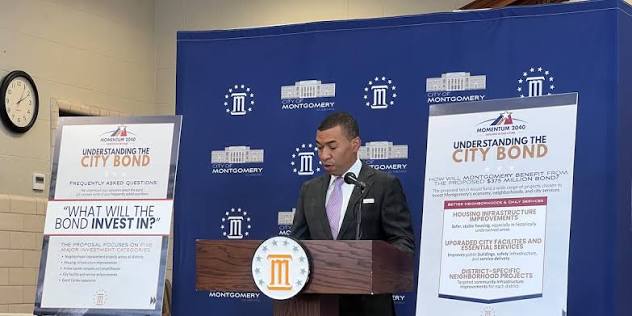
Montgomery city leaders spent part of Tuesday evening debating an ambitious plan that could reshape the city for decades.
The price tag could reach roughly $350 million.
During Tuesday’s City Council work session, council members questioned Economic Affairs Director Frank Robinson and Chief Financial Officer Betty Beville about the city’s proposed bond package and what Montgomery would actually receive in return for taking on that level of debt.
Among the major projects discussed were a new amphitheater, a recreational sports complex, a possible new police headquarters and the proposed redevelopment of the former Montgomery Advertiser property into a multimillion-dollar convention and arena complex.
The latter has increasingly become one of Mayor Steven Reed’s signature development proposals, with the apparent goal of giving Montgomery a facility capable of competing for events with cities such as Birmingham and Macon, Georgia.
Those attending the work session were presented with news coverage highlighting Macon’s investment in a major new arena facility intended to replace the roughly 60-year-old Macon Coliseum.
The message was not difficult to understand.
Other cities are investing. Montgomery needs to invest, too.
But that comparison raises a much larger question that deserves an answer before Montgomery commits hundreds of millions of dollars in borrowed money.
What exactly is Montgomery trying to fix?
And perhaps more importantly, why aren’t we making better use of what we already have?
Police, Roads and the Things Residents See Every Day
The discussion did not remain focused solely on arenas and economic development.
Multiple council members brought up frustrations they are hearing from constituents about the lack of police officers visibly patrolling neighborhoods.
Robinson and Beville said the bond package could include funding for a possible new police headquarters.
That may very well be a legitimate need.
But a new police headquarters is still a building.
Residents complaining about public safety are not necessarily asking for another building. They are asking for officers in their neighborhoods, faster responses and a police presence they can actually see.
That distinction matters.
The city’s fleet director also discussed the possibility of renting or leasing some trucks rather than purchasing them outright as the city looks for ways to control costs.
Then District 4 Councilor Franetta Riley turned the conversation toward something residents throughout Montgomery encounter every single day: infrastructure.
Riley raised concerns about badly needed infrastructure improvements, including needs in Districts 2 through 4.
Robinson’s response summarized much of the administration’s economic argument.
“You can’t have one without the other,” Robinson said. “In order to bring in money for infrastructure, we must build the arena and bring in tourism.”
Beville reinforced that philosophy with one of Hollywood’s most famous lines, quoting Field of Dreams:
“If you build it, they will come.”
Maybe.
But Montgomery taxpayers should be allowed to ask what happens if they don’t.
Before We Build Another Venue, Look at the Ones We Have
There is nothing inherently wrong with Montgomery thinking bigger.
For too long, this city has watched opportunities, events and entertainment dollars travel up Interstate 65 to Birmingham, east toward Atlanta or elsewhere around the Southeast.
Montgomery should compete.
But competing requires more than pouring concrete.
Before borrowing hundreds of millions of dollars for another arena, city leaders should explain what is preventing Montgomery’s existing venues from reaching their potential.
We already have the Montgomery Performing Arts Center.
We already have convention and meeting space downtown.
We already have Garrett Coliseum, a facility with generations of history that has spent years seemingly treated as an afterthought despite its size and location.
We already have the Riverfront Amphitheater sitting beside one of downtown Montgomery’s greatest natural assets.
Yet these facilities frequently appear underused, inconsistently programmed or almost completely absent from the broader conversation about Montgomery’s entertainment economy.
And that underuse is not just about logistics or marketing—it is also about what kind of entertainment economy the city has chosen to prioritize.
In the past, the Montgomery Convention Hall—once known as the Montgomery Civic Center—was a true regional destination. It hosted major wrestling promotions, including weekly tapings of WCW Saturday Night, along with regional NWA wrestling events that drew consistent crowds. Before the Montgomery Performing Arts Centre even existed, the Civic Center also brought in major touring concerts across every genre, from rock to country to R&B, making it a legitimate stop on national touring circuits.
Today, that kind of programming is largely gone.
The Montgomery Performing Arts Centre, while a valuable asset, is now more often booked with nostalgia acts—artists well past their commercial peak, leaning heavily on legacy appeal rather than current cultural relevance. The same pattern shows up at the Alabama National Fair, where entertainment lineups increasingly reflect a cost-driven strategy: it is cheaper to bring in lower-tier or “washed-up” acts that still draw a modest crowd, rather than investing in higher-demand performers that would actually drive significant outside spending into the city.
The result is an entertainment ecosystem that feels more reactive than competitive—focused on filling dates rather than building momentum.
Why?
That is not an anti-development question.
It is basic due diligence.
If Montgomery cannot consistently fill, market and program the venues it already owns or has available, taxpayers deserve to know why a substantially more expensive venue will produce a different result.
Is the problem capacity?
Is it outdated infrastructure?
Is it inadequate backstage space?
Is it acoustics?
Is it parking?
Is it a shortage of hotel rooms?
Are promoters bypassing Montgomery because existing facilities do not meet touring requirements?
Is the city losing events because competing markets are offering better financial incentives?
Or is the real problem that Montgomery simply has not developed an aggressive enough strategy for booking and promoting the venues it already has?
Those questions need answers before “build it and they will come” becomes the economic justification for hundreds of millions of dollars in debt.
Macon Is Worth Studying, But Montgomery Isn’t Macon
There is value in studying what Macon has done.
If another Southern city has found a successful model for replacing an aging venue and attracting concerts, conventions, sporting events and tourism dollars, Montgomery should absolutely study it.
But newspaper clippings about another city’s arena are not a feasibility study for Montgomery.
Every market is different.
Population, hotel inventory, corporate sponsorship, interstate access, promoter relationships, surrounding entertainment districts and competition from neighboring cities all affect whether an arena succeeds.
Montgomery needs its own numbers.
How many events could the proposed arena realistically attract each year?
How many would be genuinely new events rather than events shifted from existing Montgomery facilities?
What attendance is projected?
What is the expected economic impact?
What will annual operating costs be?
Who absorbs the loss if the building operates in the red?
How much additional hotel, sales and lodging tax revenue would actually flow back to the city?
And perhaps most importantly, how much of that projected revenue would be needed simply to service the debt Montgomery takes on to build everything?
Those numbers should be publicly available before the city commits itself.
$350 Million Is Not Monopoly Money
Bond financing sometimes makes enormous projects sound less expensive than they actually are.
The city does not have to write a $350 million check tomorrow.
But taxpayers should not confuse that with free money.
Bonds are debt.
Debt carries interest.
Debt requires repayment.
And the decisions Montgomery makes today can restrict what future mayors and councils are able to spend tomorrow.
That is why the infrastructure discussion during Tuesday’s work session matters so much.
Residents drive the streets every day.
They see potholes.
They see drainage problems.
They see deteriorating infrastructure.
They worry about crime.
They wonder why police visibility has declined in their neighborhoods.
Then they hear city government discussing hundreds of millions of dollars for arenas, amphitheaters and sports complexes.
It is not unreasonable for residents to ask where their neighborhood falls on that priority list.
Economic development matters. Tourism matters. Entertainment matters. Quality-of-life projects matter.
But so do streets, drainage, public safety and basic city services.
A city can build attractions for visitors while its residents increasingly question whether their own needs are being addressed.
That is not sustainable economic development.
Montgomery Does Need to Think Bigger
None of this means Montgomery should reject the bond package outright.
There is a legitimate argument for major investment.
Montgomery cannot spend the next 30 years maintaining the status quo while Birmingham, Huntsville, Mobile, Macon and other regional competitors continue investing in themselves.
Cities that stop building eventually stop growing.
But there is an equally dangerous mistake.
Building something simply because another city built something.
Montgomery’s economic-development strategy should not become a collection of expensive monuments accompanied by promises that prosperity will eventually follow.
A $350 million bond package deserves something stronger than “if you build it, they will come.”
It deserves market studies.
It deserves attendance projections.
It deserves operating-cost estimates.
It deserves an inventory of existing city facilities and an explanation of why they are currently underused.
It deserves a public accounting of how much money will go toward economic-development projects versus police, infrastructure and other essential services.
And it deserves an honest discussion about debt service and what Montgomery will ultimately repay after interest.
There may ultimately be a strong case for an arena.
There may be a strong case for a sports complex.
There may be a strong case for a new amphitheater.
There may certainly be a strong case for a modern police headquarters.
But those cases need to be made individually and supported by numbers.
Because before Montgomery spends hundreds of millions building the next big thing, someone needs to answer a much simpler question:
What are we doing with the things we already built?
Montgomery does not need to be afraid of investing in its future.
But taxpayers should be equally unafraid to demand proof that the investment makes sense.
“If you build it, they will come” worked beautifully in a baseball movie.
For a $350 million municipal bond, Montgomery deserves a little more than faith.

Jason Davenport is a seasoned media professional with over two decades of experience in the fields of broadcasting, audio/video production, and media consulting. Based in Montgomery, Alabama, Jason is the owner of Deep South Media, where he specializes in providing innovative solutions for clients, including podcasting, blogging, web design, and social media management.