
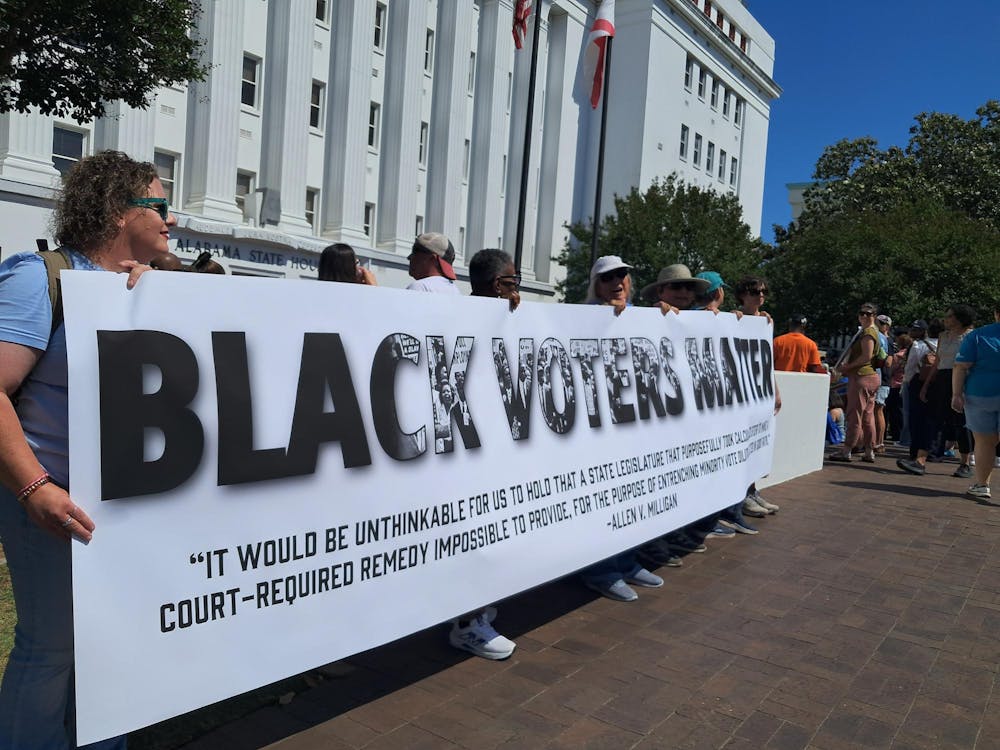
At some point during Alabama’s latest redistricting fight, the debate stopped being about maps, constitutional law, or even voting rights.
It became something else entirely: a public performance of moral superiority where disagreement itself is treated as proof of racism, greed, wickedness, or betrayal.
Over the last several days, that transformation has been on full display through statements from Democratic activists, elected officials, partisan media figures, and online commentators who increasingly frame every legal disagreement over congressional districts as a continuation of Jim Crow itself.
The loudest examples came from Alabama Political Reporter columnist Josh Moon and activist-educator KK Middleton, both of whom unintentionally exposed the deeper problem consuming modern political discourse in Alabama: emotional escalation replacing honest debate.
Josh Moon’s recent article invoked the horrors of the Civil Rights Movement — John Lewis being beaten, Jimmie Lee Jackson murdered, churches bombed, and Dr. Martin Luther King Jr. assassinated — all to frame today’s map litigation as part of the same moral struggle.
That history deserves reverence.
Not political exploitation.
Because regardless of what activists claim online, Black Alabamians are not being denied the right to vote in 2026. They are not facing literacy tests, segregated polling locations, or organized racial terror campaigns.
The actual legal dispute centers around whether race-conscious districting has constitutional limits and whether congressional maps should continue being drawn primarily around racial demographics in order to preserve preferred political outcomes.
That is a serious constitutional debate.
But instead of debating the legal merits honestly, modern Democratic rhetoric increasingly jumps straight to emotional absolutes: “Jim Crow,” “voter suppression,” “segregationists,” “racism,” and “democracy is ending.”
Moon’s article repeatedly blurred the line between modern redistricting disputes and the violence of the Civil Rights era itself.
That is not thoughtful journalism.
It is emotional intimidation.
There is a profound moral difference between arguing over district boundaries and denying citizens the right to vote altogether. Pretending those things are equivalent cheapens the suffering of people who actually endured bombs, beatings, lynchings, and assassinations.
And the contradictions only deepen from there.
Democrats routinely condemn racial gerrymandering when Republicans openly use race in map drawing. But when Democrats insist race must remain the dominant organizing principle for preserving preferred districts, suddenly it becomes “fair representation.”
You cannot simultaneously argue race should not dominate politics while demanding race dominate political outcomes.
That contradiction became especially obvious during public exchanges with activist and educator KK Middleton.
Middleton repeatedly argued that because Black Alabamians make up roughly one-third of the state population, they should possess one-third of representation across government and industries. When challenged, the rhetoric quickly escalated into accusations involving “Hitler genetics,” claims that “evil is still in the soil,” and declarations that “no debate” should even occur until preferred racial outcomes are achieved.
Then came perhaps the most revealing response of all.
Middleton insisted critics did not understand his “20 years” of background, claimed “inflation is a choice,” invoked God as the ultimate authority validating his position, referred to political opponents as “the wicked,” and argued that “real allies are never confused about the common enemy.”
Read that again carefully.
The language throughout the debate consistently divided people into moral camps:
The enlightened versus the wicked.
The oppressed versus the greedy.
The allies versus the enemy.
That is not the language of unity.
That is ideological tribalism.
And it becomes even more troubling because Middleton publicly presents himself as an educator, a man of faith, and someone interested in public leadership.
A man of faith should understand the danger of dehumanizing opponents.
An educator should understand the importance of factual precision and intellectual humility.
A potential public servant should know disagreement is not proof of evil.
Instead, this debate became a showcase for grievance politics wrapped in moral superiority.
At one point, Middleton even referenced “Clarence Thomas syndrome” — reducing a Black Supreme Court justice to a racial insult simply because he holds different constitutional views than progressive activists.
That moment exposed the core contradiction perfectly.
The modern activist left frequently claims to champion diversity and inclusion, but ideological deviation from approved racial politics is often treated as betrayal. A Black conservative is not debated on ideas. He is ostracized as racially defective for disagreeing.
That is not empowerment.
That is racial gatekeeping.
And the rewriting of Dr. Martin Luther King Jr. throughout this debate deserves special scrutiny as well.
Middleton attempted to argue that Dr. King ultimately abandoned aspects of his earlier philosophy, implying modern racial grievance politics somehow represent King’s evolved worldview. While it is true King became increasingly focused on economic inequality toward the end of his life, King never embraced the bitterness, hostility, or racial absolutism now common in online political activism.
Dr. King preached discipline.
He preached persuasion.
He preached moral courage.
He preached human dignity.
He did not preach treating disagreement itself as evidence of wickedness.
And perhaps most importantly, he understood something many modern activists have forgotten: once every opponent becomes an enemy, real civic dialogue becomes impossible.
That is exactly where Alabama politics is drifting today.
Every disagreement becomes racism.
Every policy fight becomes oppression.
Every legal debate becomes existential.
Every Republican becomes morally evil.
Every activist becomes morally infallible.
And facts increasingly become secondary to emotional performance.
For example, Middleton repeatedly claimed modern inflation is “the highest in history,” despite the objectively worse inflation crises of the late 1970s and early 1980s. When challenged factually, the discussion shifted back toward morality, spirituality, oppression, and emotional conviction instead of evidence.
That pattern is becoming increasingly common in modern political discourse:
Feelings replace facts.
Identity replaces argument.
Moral certainty replaces persuasion.
Meanwhile, the actual reality surrounding Alabama’s redistricting fight remains far less dramatic than activists portray online. Current court-drawn maps remain in place unless future court rulings intervene. Contingency legislation recently discussed by Alabama lawmakers does not suspend voting rights or erase Black political participation. It addresses potential future legal outcomes surrounding election procedures.
People can absolutely oppose those bills.
They can argue Republicans are pursuing partisan advantage.
That is fair game.
But comparing modern legislative maneuvering to Bull Connor unleashing fire hoses on children is morally reckless and intellectually unserious.
The larger issue here is not merely maps.
It is the growing transformation of political activism into permanent outrage culture, where emotional escalation becomes the primary strategy for maintaining influence, attention, and ideological conformity.
Alabama deserves better than that.
Black voters deserve equal protection under the law, not emotional fear campaigns.
And citizens of every race deserve leaders capable of persuasion instead of perpetual division.
Josh Moon is not wrong for caring about representation.
KK Middleton is not wrong for caring about struggling communities.
But both expose a dangerous reality inside modern Democratic rhetoric in Alabama: an increasing dependence on fear, racial absolutism, moral intimidation, and emotional manipulation to sustain political momentum.
Because when every disagreement requires references to Jim Crow, Hitler, segregationists, “the wicked,” and “the common enemy,” maybe the problem is not that everyone else is evil.
Maybe the rhetoric itself has become addicted to division.
Jason Davenport is a seasoned media professional with over two decades of experience in the fields of broadcasting, audio/video production, and media consulting. Based in Montgomery, Alabama, Jason is the owner of Deep South Media, where he specializes in providing innovative solutions for clients, including podcasting, blogging, web design, and social media management.